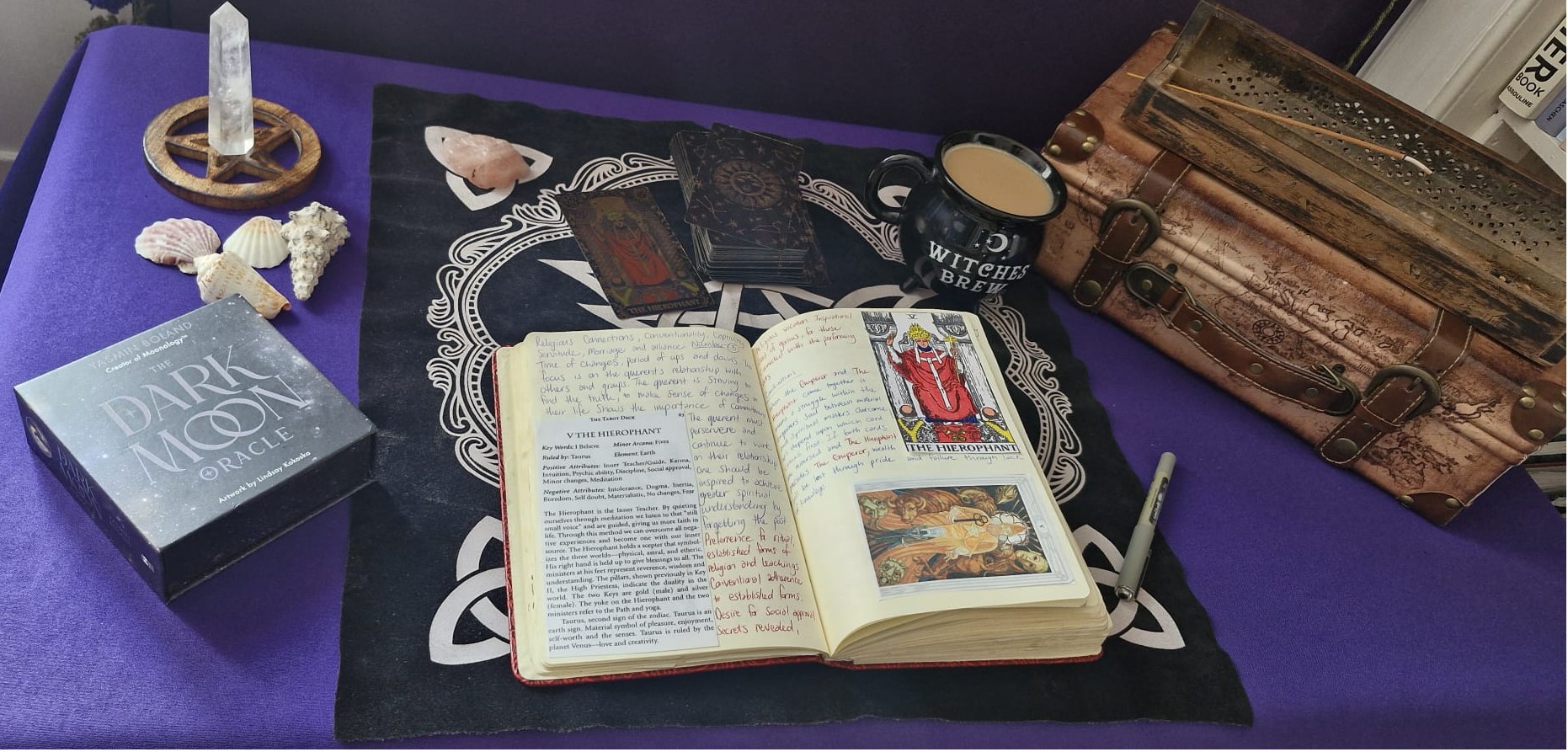
Shadow Integration
Meeting the Parts of Ourselves We Would Rather Not See
"Until one makes the subconscious conscious, no deep healing can be achieved." — Carl Jung
The time has come for me to explain exactly what shadow work is and isn't, and hopefully to broaden your understanding of a subject that not many of us outside spiritual circles are aware of. I hope there are some takeaways in the following article that may help you along on your healing journey.
What Is the "Shadow"?
Carl Jung spoke about something he called the shadow: the parts of ourselves that we reject, repress, deny, or simply do not know are there.
When you strip away all the psychological jargon, I think the concept is actually remarkably simple.
We all have parts of ourselves that we don't particularly like. Parts that don't fit the image we have of ourselves. Parts that society doesn't approve of. Parts that our parents didn't approve of. Parts that we learned very early on were not acceptable if we wanted to be loved, safe, accepted or simply left alone. So we hide them. And eventually, if we wear that mask for long enough, we forget that it is a mask.
We All Wear Masks
Think about how we learn to navigate the world. A child who learns that anger isn't acceptable may become the endlessly agreeable child. A child who learns that vulnerability isn't safe may become fiercely independent. Someone who learns that love is conditional may become a people pleaser. Someone who learns that nobody can be trusted may become emotionally self-sufficient.
These adaptations can be extraordinarily useful. They can help us survive. The problem is that we grow up. The circumstances change, but the mask can remain. Eventually, the person underneath it can grow and change so much that the identity they have constructed no longer fits.
This is one of the realisations that, for me, makes shadow work so fascinating.
Healing isn't necessarily about becoming somebody completely new. Sometimes it is about peeling back the layers and discovering who you were underneath everything you learned you had to be.
The strange thing is, you don't necessarily know what your authentic self looks like before you begin. You discover it along the way.
The Shadow Isn't Necessarily Evil
This is where I think the modern interpretation of shadow work has become somewhat confused. Shadow work has become a bit of a buzzword.
You see it all over social media: take a bath, journal, cut toxic people out of your life, call everybody a narcissist, protect your peace. There is absolutely nothing wrong with any of those things in themselves, but that isn't necessarily shadow integration.
Your shadow isn't simply all the bad things you have done, and it isn't necessarily some dark monster hiding inside you. Your shadow can contain anger, sexuality, ambition, jealousy, vulnerability, power, creativity, assertiveness and grief. It can even contain positive qualities that you were taught were unacceptable. It can contain anything that doesn't fit the version of yourself you have learned to present to the world.
This is why awareness is the first step. Before you can integrate something, you must become aware that it exists.
Awareness Before Judgement
One of the things I have learned through my own healing journey is to become curious about my reactions. Instead of immediately asking:
"What's wrong with me?"
I can ask:
- "Why did that affect me so deeply?"
- "Why do I keep repeating this pattern?"
- "What am I refusing to see?"
- "What part of myself have I abandoned?"
That doesn't mean every uncomfortable emotion is a psychological disorder. There is a danger today of pathologising ordinary human experience. People experience grief, anger, anxiety, loneliness, overwhelm and difficult periods in their lives. Sometimes these things are simply part of being human. Sometimes they are symptoms of genuine mental health conditions or trauma that require professional help. There is a distinction.
This isn't a substitute for therapy, psychiatry or medical treatment, and I certainly don't claim to be a therapist. I am simply talking about shadow integration from my own experience, observation and spiritual perspective.
For me, the value of shadow work is that it gives us another question to ask:
What is this experience showing me about myself?
Not every answer will be comfortable, but uncomfortable doesn't necessarily mean bad. Sometimes discomfort is information.
You Are Not What Happened to You
This is probably one of the most important things I have learned.
You are not your circumstances. You are not what happened to you. And you are not necessarily the person you had to become in order to survive those circumstances. This is particularly important for anyone who has experienced trauma.
I am not saying that people are responsible for the terrible things that have happened to them. They aren't. But I do believe there comes a point where the question changes. It moves from:
"Why did this happen to me?"
towards:
"What can I do with what happened to me now?"
Those two questions can coexist.
It wasn't my fault.
And:
My healing is now something I can participate in.
That is agency.
Agency doesn't mean that we can control everything. We can't. Some people are born into horrific circumstances. Some people experience things they never should have had to experience. But even when our choices are limited, there can still be a small space in which we can choose. Sometimes that space is enormous. Sometimes it is tiny. But small increments count: one decision, one boundary, one honest conversation, one pattern recognised, one thing done differently. That can be the beginning.
The Shadow in Our Relationships
One of the places where the unintegrated shadow can become particularly obvious is in our relationships. We can project things onto other people that we cannot tolerate within ourselves. We can repeatedly choose familiar dynamics because familiar feels safe, even when familiar is unhealthy. We can become attracted to people who recreate patterns we thought we had escaped. We can become controlling because we are terrified of being powerless. We can become emotionally unavailable because vulnerability feels dangerous. We can become dependent because being alone feels unbearable.
Sometimes addictive behaviours can serve a similar purpose. Addiction is enormously complex and has biological, psychological and social dimensions, so I would never claim that an unintegrated shadow is the explanation for addiction. But shadow work can give us some interesting questions to ask:
- What is this behaviour doing for me?
- What am I trying not to feel?
- What am I trying to escape?
- What need is being met?
- What part of myself have I been unable to face?
The same principle can apply when we look at narcissistic traits such as grandiosity, contempt, projection, defensiveness or an inability to tolerate vulnerability. Again, I am not diagnosing anybody. I am simply asking whether the persona we construct to protect ourselves can become so rigid that everything which contradicts it gets pushed into the shadow.
The person who absolutely must appear strong may have buried their vulnerability. The person who must always be right may be unable to tolerate shame. The person who needs admiration may have become completely disconnected from their own sense of worth. What we refuse to acknowledge doesn't necessarily disappear. Sometimes it simply finds another way out.
When the Persona Becomes the Life
This is another aspect of Jung's work that I find fascinating.
Imagine somebody who has built the perfect life: a successful career, a beautiful house, money, status, a perfect family. Everything society tells us should constitute success. From the outside, everything looks wonderful. But perhaps behind closed doors this person is drinking heavily every night. Perhaps they are desperately unhappy. Perhaps they are living a life they don't actually want because, somewhere along the way, the persona became more important than the person.
The mask has become the life.
And this can happen to anybody. We can become so identified with being the successful one, the good mother, the strong man, the spiritual person, the independent woman, the perfect child or the responsible one that we forget these are roles. They are not necessarily the entirety of who we are.
Underneath the mask, we continue to grow. That is the problem. The inner self changes, but the outer identity can remain frozen. Eventually there can be a terrible disconnect between the person you have become and the person everyone believes you are. Shadow work can begin to expose that disconnect.
Shadow Work Is Not About Endlessly Digging for Trauma
This is something I feel very strongly about. You cannot force healing. There is such a thing as pushing yourself too hard.
There is a difference between becoming aware of your unconscious patterns and spending your entire existence digging through your subconscious looking for another wound to heal. Sometimes the most profound shadow work is to stop. To rest. To live. To laugh. To create something. To have an ordinary day. To allow something that has surfaced to settle.
Healing isn't another achievement to tick off your list, and nobody should feel that they have failed because they aren't constantly "working on themselves." Some people aren't drawn to this work at all. And that is okay.
Not Everyone Has to Awaken in the Same Way
This is where my own spiritual beliefs come into the picture. I believe that every soul has its own journey. Not everybody is interested in spirituality. Not everybody wants to meditate, read tarot, work with crystals, study Jung or explore the occult.
One of my closest friends is a perfect example. His spirituality is music. He is perfectly content with a simple life. He doesn't need to spend his time analysing consciousness or exploring esoteric traditions, and who am I to tell him that he should? That is his journey. Perhaps somebody else's path is motherhood. Another person's is art. Another's is science. Another's is caring for animals. Another person's greatest spiritual experience might simply be standing beside the sea and feeling completely at peace.
There is no hierarchy here.
I don't believe that someone who has read fifty books on occultism is automatically more spiritually evolved than someone who has never opened one. Spirituality isn't a competition, and shadow work certainly shouldn't become another way of feeling superior to people who aren't doing it.
The Spiritual Perspective
This is where Jung's ideas begin to intersect, for me, with the Western occult tradition. Jung gave people a psychological language with which to understand things that spiritual traditions had been talking about for centuries. The idea of polarity is found throughout occult philosophy: light and darkness, masculine and feminine, creation and destruction, conscious and unconscious.
In Kabbalistic and later occult traditions, we encounter the Sephiroth and the Qliphoth: the Tree of Life and the concept of the shadow, or husks, surrounding it. I am still a student of these systems myself, so I am not going to pretend to be an authority on something I am still learning. But there is a principle here that resonates deeply with my own practice: the microcosm reflects the macrocosm.
We are not simply a drop in the ocean. We are, in a sense, the ocean in a drop.
What exists within us is reflected in the greater patterns we encounter outside ourselves. If you accept that premise, then there is a very good reason to begin with yourself. Before you start attempting to navigate the shadow realms, perhaps you should first become acquainted with the shadows within your own psyche. Before you attempt to command forces you cannot control, learn to govern yourself.
Why This Matters in Occult Practice
I work within a Left-Hand Path framework, and one of the things I have observed is the fascination people have with Goetia and so-called demonic forces. I also work in an esoteric environment, and I have seen this repeatedly. People who feel powerless can become fascinated with the idea of commanding something powerful. I sometimes wonder whether the attraction is actually the entity at all. Perhaps it is the promise of power:
"If I can command something frightening, perhaps I am no longer powerless."
"If I can make something else do my bidding, perhaps I finally have control."
That, to me, is precisely where shadow work becomes important.
What are you actually seeking?
Revenge? Control? Money? Recognition? Protection? Power over somebody who hurt you? Or are you genuinely seeking knowledge and transformation?
I am not here to tell anybody what spiritual beings are or are not real. That is a question people will answer according to their own beliefs and experiences. For me, magic and the spirit realm are undoubtedly real. But whether you understand these encounters psychologically, spiritually, symbolically or literally, there is one principle I think is worth considering:
You bring yourself with you.
Your fears come with you. Your desires come with you. Your unresolved trauma comes with you. Your ego comes with you. Your shadow comes with you. And there are beings who love nothing more than to use your shadow against you for sport.
Should you enter an intense spiritual practice without having examined those things, perhaps the first thing you encounter isn't the magnificent cosmic mystery you were expecting. Perhaps you encounter yourself.
Power Reveals the Person Holding It
There is a question I sometimes think about:
If you woke up tomorrow with the power of a god, what would you do with it?
Would you become rich? Would you take revenge on everyone who had ever hurt you? Would you make people love you? Would you control other people? Would you save the world? Would you heal someone you love? Would you mend the wing of an injured animal? Or would you simply observe, and intervene only when absolutely necessary?
There isn't necessarily a right answer, but your first instinct might tell you something about yourself. If your immediate thought is, "I'd finally get revenge on everyone who hurt me," perhaps there is still some work left to do. That isn't a condemnation. It is information.
True power, in my opinion, isn't necessarily the ability to use power. Sometimes it is having the ability and knowing when not to use it. There is an old principle in martial arts that it is better to know how to fight and never have to fight than to need to fight and not know how.
"It is better to be a warrior in a garden than a gardener in a war." — Old Chinese proverb

I think there is something similar in occult practice.
Know yourself before you seek power.
The Light Doesn't Remove the Shadow
This applies equally to people who work exclusively with what they perceive as light. It is very easy to become obsessed with angels, higher frequencies, ascension, positivity and spiritual purity while refusing to acknowledge anger, sexuality, jealousy, grief, resentment, ambition or ordinary human ugliness. That isn't necessarily integration. Sometimes it is avoidance, and it is often called spiritual bypassing.
The shadow isn't something that needs to be destroyed. It needs to be known.
We are human beings, and human beings possess a tremendous capacity for both creation and destruction. Good and evil, in the way I understand them, are not simply external forces that exist somewhere "out there." They are also choices we make with what we have been given. Power doesn't automatically make somebody good. Knowledge doesn't automatically make somebody wise. Spiritual experience doesn't automatically make somebody integrated.
The question is: what do you do with what you have learned?
So What Actually Is Shadow Integration?
Perhaps, after all these words, the simplest definition is this:
Shadow integration is the process of becoming conscious of the parts of yourself that you have rejected, repressed or failed to recognise, and learning to relate to them consciously rather than allowing them to control you unconsciously.
It isn't about becoming perfect. It isn't about becoming permanently happy. It isn't about getting rid of your darkness. It isn't about diagnosing everybody around you. And it certainly isn't about becoming "more evolved" than everybody else.
It is about becoming more conscious. And perhaps, ultimately, it is about becoming less divided against yourself.
You Don't Have to Do This
This is perhaps the most important thing I want anybody reading this to understand.
You don't have to embark upon shadow work. You don't have to go looking for trauma. You don't have to become an occultist. You don't have to believe in Jung. You don't have to believe in spirits. You don't have to believe in reincarnation. You don't even have to believe in a higher self. If you are happy living your life as it is, then live it.
But if something inside you keeps asking questions...
- "Why do I keep doing this?"
- "Why does this trigger me?"
- "Why am I repeating the same relationships?"
- "Why do I feel empty despite having everything?"
- "Who am I underneath all these roles?"
- "What am I afraid to look at?"
...then perhaps there is something worth exploring.
Not because somebody on TikTok told you that you have shadow work to do. Not because a spiritual teacher told you that you're unhealed. Not because I am telling you. But because you are curious.
That is where it begins. Awareness. And from awareness comes choice. And from choice comes agency.
We Don't Get to Choose Everything
I don't believe that we get to choose everything that happens to us. We don't. We don't choose the family we are born into. We don't choose every trauma. We don't choose every loss. We don't choose every circumstance. But we can sometimes choose what we do with what happened to us.
That doesn't happen overnight. Healing is rarely a straight line. Sometimes you move forward. Sometimes you fall back. Sometimes you discover that something you thought you had healed still has something to teach you. That's okay. You are not failing. You are human.
And perhaps forgiveness is part of this too. Not necessarily forgiving the people who harmed you, but forgiving yourself: for the things you did when you didn't know another way, for the ways you survived, for the years you lost, for the people you became, for not knowing then what you know now.
The point isn't to rewrite the past. It is to stop allowing the past to write the entirety of your future.
The Invitation
I have arrived at many of these ideas through my own experience, my own spiritual practice and my own mistakes. Then, sometimes years later, I have encountered something in Jungian psychology or the Western occult tradition that made me stop and think:
"I've been thinking about this for years. Someone else has already written about it."
That doesn't make my experience proof. It doesn't make Jung infallible. It doesn't make an occult tradition objectively true. It simply reminds me that human beings have been asking these questions for a very long time.
So I don't want you to take my word for any of this. Research it. Read Jung. Explore the traditions. Question what you read. Disagree with me. Find something that resonates. Find something that doesn't. And most importantly, think for yourself.
The purpose of shadow work, at least as I understand it, isn't to replace one authority with another. It isn't about somebody telling you who you are. It is about becoming conscious enough to begin discovering that for yourself.
Before you attempt to command the darkness outside yourself, learn to meet the darkness within. And perhaps, when you do, you will discover that it was never quite as frightening as you thought. Perhaps it was simply a part of yourself that had been waiting to be seen.
Eternal Inner Light,
Chrystal
Suggested reading: Carl Jung; The Body Keeps the Score by Bessel van der Kolk; Complex PTSD: From Surviving to Thriving by Pete Walker